Fingers and toes

BBC: Finger length 'key to aggression'

No it isn't.

The BBC's headline is committing the common (and sloppy) mistake of confusing a correlation with a causational relationship. Here is what the article actually says:

The length of a man's fingers can reveal how physically aggressive he is, Canadian scientists have said. The shorter the index finger is compared to the ring finger, the more boisterous he will be…

The trend is thought to be linked to testosterone exposure in the womb.

In other words, finger length and aggression are both thought to be affected by a common factor (you'll note I didn't say cause), namely testosterone. But to say that finger length is the 'key to aggression' (albeit in quotes) is like saying that the coldness of my toes is the 'key to the snow' in my garden.

Time to get off my hobby-horse and put on some thicker socks.

Published
Filed under: Nonsense

Another one bites the dust

BBC: Saddam's half-brother 'captured'
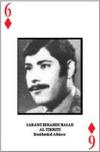
A half-brother and one-time aide to former Iraqi leader Saddam Hussein has been captured, according to Iraqi interim government sources. Sabawi Ibrahim al-Hasan al-Tikriti was number 36 on the US military's list of 55 most wanted former regime members.

It would appear that Saddam Hussein isn't the only member of his family to bear an uncanny resemblance to someone else. His brother is the spitting image of Queen's dead frontman, the late, great Freddie Mercury:

Freddie Mercury
Mercury.
Sabawi Ibrahim al-Hasan al-Tikriti
Hasan.

Totally, totally uncanny!

You don't say

Guardian: Report doubts future of wind power

Wind farms are an expensive and inefficient way of generating sustainable energy, according to a study from Germany, the world's leading producer of wind energy.

The report, which may have ramifications for the UK's rapidly growing wind farm industry, concludes that instead of spending billions on building new wind turbines, the emphasis should be on making houses more energy efficient. Drawn up by the German government's energy agency, it says that wind farms prove a costly form of reducing greenhouse gases.

See also:

Postscript: Oh yes, and while I'm at it…

RSPB: RSPB lodges official objection to world's largest onshore wind farm

The RSPB is formally objecting to a massive wind farm development proposed for the Isle of Lewis in the Hebrides.

The proposal by Amec and British Energy (Lewis Wind Power Ltd) would involve the construction of 234 wind turbines on an extremely fragile and special wildlife site on the north Lewis moor. The wind farm would have a 25-year lifespan.

The RSPB is objecting in the strongest terms to the proposal because the turbines would be spread across the Lewis Peatlands Special Protection Area (SPA) - an area protected under European law for a variety of important birds, including golden eagles, merlins, black-throated divers, red-throated divers, dunlins and greenshanks.

'We believe this wind farm proposal is not just bad for birds but bad for the development of renewables as well,' said Anne McCall, RSPB Planning and Development Manager.

Published
Filed under: Nonsense

Whoooooosh!!!

Ladies and gentlemen, they said it would never happen out here, half-way up a hill in the back of beyond, but, wait for it…

We have broadband!!!

My, that was fast! Where should I go next?

Published
Filed under: Nonsense

…and meanwhile back

I recently discovered what Ann would no doubt describe as a snookie—an obscure, roundabout route which is actually quicker than going the sensible way, provided you don't get lost—near her old house in Liverpool. Liverpool is mad busy with roadworks at the moment, thanks to the Capital of Culture thing. Out of necessity, I have been discovering a lot of new snookies lately.

So it was that, yesterday evening, I found myself playing the Beatles' Drive My Car while actually driving my car down Penny Lane. Yes, that Penny Lane.

Talk about spooky synchronicity or what?

I didn't see any sign of a barber showing photographs, a banker with a motor car, or a fireman with an hour-glass, but I did see a Wash-o-Rama laundrette, a Sgt. Pepper's restaurant, and about a dozen speed bumps. Signs of the times, I guess.

Say what you like about the Beatles, but they did have a gift for song titles: Lucy In The Sky With Diamonds, Norwegian Wood, Ob-La-Di, Ob-La-Da—pure genius.

Only Lennon and McCartney could spot the potential of a name like Penny Lane. It's the perfect song title.

If it had been down to me, I would probably have plumped for the adjacent road: Croydon Avenue.

Published
Filed under: Nonsense

Doing the maths

Sunday Times: Hunts kill 91 foxes on first day of ban
On the first day of the hunting ban 250 hunts rode out into the wintry sun and killed no fewer than 91 foxes. It looked very much like business as usual, apart from some huntsmen dragging effigies of Tony Blair for their hounds to pursue.

I've been doing some maths:

  • I don't know the size of a typical hunt, but as a conservative (in both senses of the word) estimate, let's say it's 30 horse-faced toffs and associated hangers-on, plus a pack of, say, 30 dogs. (I'll ignore the horses, hunt saboteurs, police, and Sunday Times journalists to keep it simple.)
  • That's 7,500 people and 7,500 dogs working a whole day to kill 91 foxes.
  • That's 0.0121 foxes per person/dog per day.
  • That's 82½ person/dog days to kill a single fox.

Doesn't that strike you as spectacularly inefficient?

It makes a lie of their argument that fox hunting is was all about pest control.

Either that, or the hunting ban has been highly successful in reducing the number of foxes killed for fun.

Published
Filed under: Nonsense

I lavva birra kalcha!

Guardian: Official: Britons are most cultured Europeans
The Italians have Michelangelo, the French Molière and the Germans Beethoven. But, according to an Italian survey, the British—the beer-swilling, tabloid-reading, supposedly sports-crazy British—are more cultured than any of them.

Presumably, that's cultured as in Petri dish.

This sort of snobbery really winds me up: beer-swilling, tabloid-reading and watching sport are cultural. You can't compare amounts of culture; everyone in the world is surrounded by the stuff 24 hours a day.

Unless they live in Dumfries.

Published
Filed under: Nonsense

Sixth scents

Not only did animals use a mysterious sixth sense to escape the recent dreadful tsunami, but it would appear that supposedly primitive people (who, as we all know, are much more in tune with their environment than we are) also saw it coming—although saw isn't exactly the word:

BBC Radio 4, Thinking Allowed (16-Feb-05): What is the role of the senses in society? Why do many people in west-African societies hold hands when they talk? Did a group of islanders in the Bay of Bengal really 'smell' the Tsumani coming? And thus survive?

No, they didn't.

Of course, the sociologist and Thinking Allowed presenter, Prof. Laurie "I misquote people on air to make them sound stupid" Taylor, being a total expert on the scientific hypothesis front, immediately challenged the utterly preposterous assertion made by this week's guest, David Howes, Professor of Sociology and Anthropology at Concordia University in Montreal, that the members of an ancient tribe in the Andaman Islands smelt the tsunami coming. Here is what Prof. Taylor said:

Yes, that's right, he didn't even bat an eyelid. Nice one, Laurie!

Why do people always have to look for mysterious explanations? The BBC has already published a far more sensible account of how the ancient tribes of the Andaman and Nicobar Islands happily managed to survive the tsunami:

BBC (20-Jan-05): Tsunami folklore 'saved islanders'

Traditional knowledge handed down from generation to generation helped to save ancient tribes on India's Andaman and Nicobar Islands from the worst of the tsunami, anthropologists say…

The aboriginal tribes—some of the oldest and most isolated in the world—have oral traditions apparently developed from previous earthquakes that may have allowed them to escape to higher ground before the massive tsunami struck the island chain off Indonesia.

The Onge tribe, for example, have lived on Little Andaman for between 30,000 and 50,000 years and, though they are on the verge of extinction, almost all of the 100 or so people left seem to have survived the 26 December quake and the devastating waves which followed.

Their folklore talks of "huge shaking of ground followed by high wall of water", according to Manish Chandi, an environmental protection worker who has studied the tribes and spoke to some Onges after the disaster.

No voodoo. No mysterious sixth sense. Just good old-fashioned folklore.

See also:

Published
Filed under: Nonsense