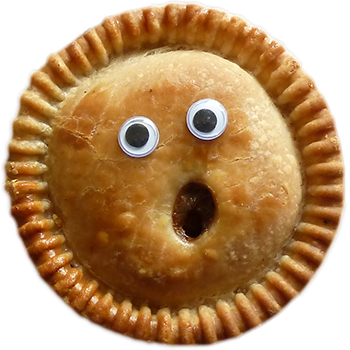
Pib

For reasons I won't bother you with, I was thinking about the syllable pib yesterday.

As syllables go, it's not all that unusual: consonant-vowel-consonant, easy to pronounce, not an actual word—but there's no reason on earth why it couldn't be.

Then I tried to think of words which begin with the syllable pib. I eventually came up with pibald.

I found pibald a totally unsatisfactory answer to my self-imposed challenge to find a word beginning pib_ for two reasons: (1) piebald is how I (and, I hope, most other people) would normally spell the word, and, more importantly, (2) the letters P, I, B are not pronounced as a single syllable: it's pi-bald. Like I said, totally unsatisfactory.

So I racked my brains for a while, trying to come up with another word which begins pib_. I failed.

So I've just looked in my Compact Oxford English Dictionary (the full-hit dictionary printed so small that it comes with a magnifying glass to help you read it), and here are the pib_ words listed in it:

  • pibald
    already got that one!
  • pibil/pibble/pible
    an obsolete spelling of pebble
  • pibble-pabble
    an alteration of bibble-babble (obviously)
  • pibcorn
    an obsolete word for a form of hornpipe formerly used in Wales
  • pibling
    some famous writer's misspelling of pipling (the dolt!)
  • piblokto
    a form of hysterical illness in Eskimo dogs (no, really!)
  • pibroach/pibrach
    variations on a particular musical theme for bagpipes in the Scotch (sic) Highlands

So now I know.

I wonder why so few words begin with pib_.

(Don't get me started on beb_.)

Bosh

I've just worked out why, when the Halifax Bank merged with the Bank of Scotland to make HBOS, they chose to merge the two banks' initials in the order that they did.

Better inoculate than never

Sunday Times: No MMR? Then you won't start school

Children will be banned from starting school until they receive the MMR jab, under new Labour party proposals. Parents will have to provide proof their offspring have had a full range of vaccinations when they put in applications for primary schools.

You've got to hand it to this Labour government: in power for over a decade, and they're still somehow managing to dredge up new stuff to ban. Who says they lack imagination?

If you remember, back in February, I proposed a much more logical solution to this MMR nonsense.

Incarnadine

The more observant of you—the more observant of you who are not reading this via an RSS reader at least—might have noticed that the banner across the top of the page has changed from a tasteful orange colour to a rather dramatic red. At the same time, the text has changed from black to white.

Why have I made this change? Well, exactly the same red and white colour scheme will soon be adorning my new study. The shelves, windows, skirting board and ceiling will be white, and the walls red. This exact red, in fact. For some reason, the paint manufacturer has chosen to call it incarnadine. It's a disappointing name, compared with those of some of the other reds I was tempted by: blazer, dragon's blood, volcanic splash, and something I can't remember with the word passion in the title. Even rectory red has more of a ring to it than incardanine. Didn't he star in Kung Fu in the 1970s?

Unfortunately, incarnadine turns out to be a rather specialist (for which, read expensive) paint, so the shop didn't have enough. They've had to order some more.

The new study, once it has a desk and computer will become the official new Gruts Central. So I thought I might as well change the colour scheme at the top of the page to be a bit more corporate.

I don't know how long it will last.

BBC News web team goes for headline of the month

Makes you proud to be British.


Postscript: From an online chat with Carolyn later in the evening:

Richard: Can I ask you a (slightly personal) question?
(It's not all that personal, in case you're worried.)
Carolyn: Ok but I have to go very soon.
Richard: Thanks…
In your experience, is the headline on this news story true?
http://news.bbc.co.uk/1/hi/sci/tech/7390109.stm
Carolyn: Yes.
Richard: Excellent!

More ducks than is usual

Pensive duck
A pensive duck recently.

Is it my imagination, or are there more ducks than is usual for the time of year flying about at the moment? Not significantly more, but noticeably more. Noticeable enough that, if you happened to have a website where you were prone to make observations of such a nature, you would probably mention it on the off-chance that you had actually noticed something rather profound. I admit it seems unlikely, but you never know: perhaps there's a reason why there are noticeably more ducks flying around than is usual for the time of year. Or perhaps it really is just my imagination.

They're mallards mostly, from what I can tell at the sort of distances I'm talking about. Actually, I haven't mentioned distances yet, but I'm just about to: 50 to 100 yards, approximately. They tend to be flying very fast, very low and very determinedly in a straight line, quite often in an easterly direction. I suppose they could be the same ducks going round and round, but this seems unlikely, bearing in mind how very determinedly they are flying in a straight line. Not to say impossible.

Ducks are surprisingly fast fliers. In fact, I'm pretty sure my edition of The Guinness Book of Records from some time in the 1970s said that the fastest horizontal bird flight ever measured was that of a mallard. I forget the speed. Peregrine falcons can reach faster speeds, of course, but only in a vertical stoop.

A surprising thing I've noticed about ducks' flight while I've been observing the noticeably more of them than is usual for the time of year recently is how short their wing-beats are. They're very short indeed, bearing in mind the horizontal speeds they achieve. Ducks take tiny wing-beats, but travel at great speed.

There's a lesson for us all there, I think.

Trouble brewing

BBC: Nuclear threat sparked tea worry

The threat of a nuclear attack on the UK in the 1950s caused concern over the supply of tea, top-secret documents which have now been released reveal.

Government officials planning food supplies said the tea situation would be "very serious" after a nuclear war.

Those were the days: a UK government actually getting its priorities right. Tea had got us through two world wars, and we were going to need reliable supplies to make it through a third.

Happy KettleOf course, it all started going downhill in 1938 with the invention of Nescafé. Now, we've turned into a nation of hyperactive, migrane-ridden instant coffee swillers. It was all part of a sinister American plot to destroy our empire.

More tea? Don't mind if I do!