BBC: Humphrey Lyttleton: Your comments
I shall miss writing to you.
Mrs Trellis, North Wales
My ears stand up when I hear that sound…
The ultimate train song: Captain Beefheart & the Magic Band - Click-Clack:
Humph
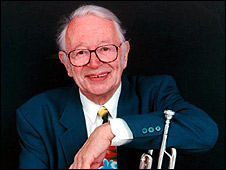
The world is a less happy place.
Arbroath smokies
Jen and I had Arbroath smokies for our lunch last Saturday.
Jesus!
For those of you not in the know, an Arbroath smokie is a smoked haddock from the village of Arbroath in Scotland. (Those of you who are already in the know will not need to be reminded.)
Have you ever stood a bit too close to a bonfire and accidentally inhaled more than is strictly good for you, so that you end up coughing your lungs out, and all you can taste for the next three days is bonfire? Well, that's what eating an Arbroath smokie is like.
I'm not kidding, after a meal of pie and peas and a couple of beers on Saturday evening, I gave a discreet, satisfied burp, and all I could taste was that afternoon's Arbroath smokie.
Fantastic!
You certainly get your money's worth with an Arbroath smokie. It's the smoked fish equivalent of a glass of Laphroaig. And you won't get any higher praise than that from this astute gourmand.
Walking a borrowed dog this evening…
Me: Bloody hell! Do you know what that is?
Jen: What, the cow?
Me: It's not a cow, it's a bloody buffalo! You don't see many of those in Yorkshire!
Jen: I don't know… There's another one over there.
A buffalo! Honest injun! No bull!
Jumping to the obvious conclusion
Jen and I have a couple of phrases we like to use tongue-in-cheek when one of us puts forward a totally ridiculous hyphothesis: "There you go: jumping to the obvious conclusion yet again" and "It's the only logical explanation". A typical conversation might go something like this:
"Have you seen the cheese-grater? It's not in the drawer."
"I think it must have been stolen by aliens wanting to learn about our advanced technology."
"There you go: jumping to the obvious conclusion yet again!"
"It's the only logical explanation."
Our use of these phrases is intended as a tribute to the many thousands of nutters out there who come up with horse-shit hypotheses which, for some bizarre reason, they genuinely expect us to believe.
This from the London Review of Books letters page earlier this month:
What Really Happened
Frank Kermode does not include in his discussion of the resurrection the gospel reference that gives the best clue about the death and resurrection of Jesus, namely John 19.34: 'Forthwith came there out blood and water' (LRB, 20 March). There can be only one possible explanation for this happening after the spear had been thrust into his side: Jesus had a large pleural effusion, which the spear released. This diagnosis explains a good deal that is otherwise puzzling in the gospel stories. Although he had previously walked everywhere, Jesus needed an ass for his final entry into Jerusalem. Also, he was unable to carry his cross, which other men of his age could carry easily. A pleural effusion this size would have been accumulating for some time. It would have been tuberculous, and so Jesus would have been getting steadily weaker. It isn't surprising that he felt 'he was not long for this world.'
The story in John implies that the soldiers were surprised to find Jesus dead so soon. With the effusion pressing on his heart and his body fixed upright he would probably have gone into severe heart failure, and would have appeared dead even though his heart itself was perfectly sound. The spear blow that was expected to finish him off might actually have saved his life by relieving the pressure on his heart. Being laid horizontally would have allowed the blood and fluids pooled in his legs to return into circulation, a process assisted by the coolness of the tomb. He might, in these circumstances, have regained consciousness and thus have seemed to be resurrected.
Dr Roger James
Portsmouth
This chap's got real class. You can read Frank Kermode's response here.
(The cheese-grater was in the dishwasher, by the way.)
See also: Talking through their Eridanus hole
From flies to guys
BBC: Flies get 'mind-control sex swap'
Scientists have been able to take control of flies' brains to make females behave just like males.
The scientists simply removed the female flies' brains, and they immediately began drinking lager, farting and talking incessantly about football.
(I thought I'd better say it before Jo Brand did.)
My mate Clive
I know it must seem patently obvious, but, in case you were in any doubt, I'd better say this up-front: I really don't plan any of this crap beforehand, you know…
A week last Sunday, I urged you all to listen to what World-Cup-winning former England rugby coach, Sir Clive Woodward, had to say.
This afternoon I quite unexpectedly found myself doing just that—in the flesh, so to speak.
Don't believe me, huh?

Admit it: you're mildly impressed.
See also:
Gruttish
On 14th March, 1859, while in the middle of writing On the Origin of Species, Charles Darwin wrote to his oldest son:
Mrs Grut is more "gruttish" than ever, & almost talks one deaf, & can be consumedly saucy.—
Two days later, Mrs Grut's employment as children's governess at the Darwin household was terminated as a result of her volatile and insolent behaviour.
I have to say, I am deeply disappointed that my personal hero, Charles Darwin, didn't get on with someone going by the rather wonderful name of Mrs Grut. But I am delighted that he coined the word gruttish: a very useful adjective, I'm sure you'll all agree.
But what do you think it means?
The Prodigal Hamster
If Jesus had incorporated talking animals into his parables, they might have appealed more to a younger audience.