🦆
As it's my birthday today (thanks, chaps, you really shouldn't—oh, that's right, you didn't), and I'm in a good mood, how about a quick round of the Nun Game?
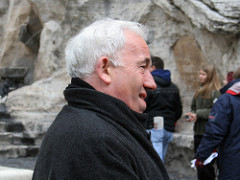
Twenty-five points and one of my spare Moleskine™ notebooks to the first person to spot a nun hidden away in my recent photos from Rome and Florence. Answers in the comments please.
Simply post the URL (web address) of the Flickr page containing the nun photo into the comment's text. (Note: There should only be one photo on the Flickr page in question. If there is more than one photo shown, click your chosen photo to be taken to its unique page.) Oh, and don't forget to include your email address in the comments field provided, so I'll be able to contact you (it won't be published).
For the avoidance of doubt, there are no tricks involved. There is at least one photo of a real, live nun, who is very clearly a nun, and not just some indistinguishable speck/blob in the background.
Think of it as Where's Wally, but with nuns.
The judge's decision is final, no correspondence will be entered into, etc., etc.
Good luck!
Oh, is it empty already? Next bottle, I think.
Postscript: We have a winner. Congratualtions, Philip. The nun photo is here.
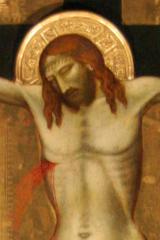
OK, even I'm starting to get bored of all this Italy stuff now. But, before I finish, I must explain my theory that Jesus was a carrot-top:
When you've traipsed through as many medieval art galleries and churches as I have in the last couple of weeks, you begin to notice certain themes developing.
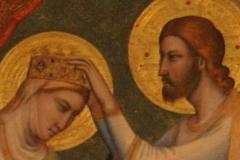
For example, it is quite clear that Jesus was an extremely ugly baby. Out of the (literally) hundreds of Madonna and Childs and Nativities that I saw, there wasn't a single one in which Baby Jesus didn't look boss-eyed, deformed, or just not-quite-right-in-the-head. He had the sort of face that only a mother could love. And he's nearly always clutching some poor goldfinch in his mitts. What the hell is that about? Some sort of religious iconography I can't be bothered to look up, I'll bet. [Postscript: Actually, I've now looked it up, and very symbolic it is too.]
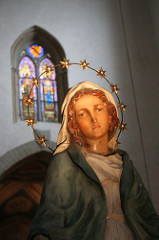
And very often, the Virgin Mary is shown with two kids. It turns out the second one is Jesus's cousin, John the Baptist. Presumably he was Jesus's cousin on his mother's side. I suspect Mrs The Baptist was a working mum. Either that, or she and the Virgin Mary took it in turns to look after the kids while the other popped down the shops.
The other thing you soon begin to notice in these old painting is that Jesus was extremely white, and unforgivably ginger. I don't mean in just one or two painting; I mean in practically all of them (with one notable exception: a Russian iconographic painting in which he looked decidedly swarthy).
I mean, even his poor mum looks ginger in some of the paintings. As if she didn't have enough to worry about, the poor woman!
I rest my case. Here endeth the lesson.
To win, all you need to do is engage some Americans in polite conversation, then ask them which part of Canada they're from before they ask you if you're from Australia.
Sounds dead simple, but I'm 3–0 down at the moment.
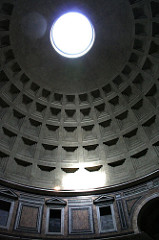
I have wanted to visit the Pantheon in Rome ever since I saw some slides of the place in an archaeology lecture in 1985. Remember slides? As domes go—proper domes, that is, not silly tents in Greenwich—the Pantheon's is the daddy. I am delighted to report that it was every bit as fantastic as I'd hoped it would be. The Romans knew a thing or two about domes—and about concrete, from which it is made.
The Romans also knew a thing or two about ecumenism and diversity: as its name implies, the Pantheon was originally a temple to all the gods. Then the Christians came along, nailed up a few crosses, and converted the place into a church. Don't you just hate it when they do stuff like that?
As an atheist, I have rejected all gods as being a silly idea. Compare this with Christians, Moslems and Jews, who have rejected all gods except one. It's that last step that's the hardest, apparently. Come on in, chaps, the water's lovely!
But it seems to me that, if we aren't all going to see the light and become atheists, pantheism has got quite a lot going for it. If you accept, as the Romans did before Constantine sold out, that there are literally hundreds of gods, all of which/whom/whatever deserve some element of respect, then you are far less likely to cause a ruckus by claiming that your particular favourite god is the one true god. Panthism is bound to make you a tad more tolerant. Even more tolerant than us liberal atheists, who think everyone else is totally fucking nuts, but fully respect their right to be stupid.
When they invaded Britain, for example, the Romans heard about the local goddess Sul who was supposed to inhabit a water spring in the South West. Rather than say pish and tush, they adopted Sul, saying she sounded a bit like Minerva to them, and named the spring Aquae Sulis in her honour. We now call the city that grew up around the spring Bath. The Romans were particularly good at assimilating other religions into their theology.
The Christian/Moslem/Jewish god (if He is indeed the same chap), on the other hand, is a jealous god: "Thou shalt have no other gods before me," He said. But note the implication of the one true god's Commandment Numero Uno to Moses: no other gods… The Lord in His infinite wisdom was clearly acknowledging that other gods did exist. Furthermore, He was not saying that you shouldn't respect other gods; just that you shouldn't rate them higher than Him.
Which kind of makes you wonder why on earth people make such a big deal about monotheism.
There's no way on earth this place was built in a day:
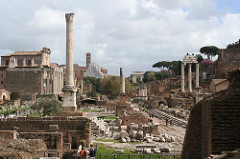
It should be quite impressive once it's finished.
Whenever Jen and I are in Italy, we like to play the Nun Game. Well, to be honest, it's just me who likes to play the Nun Game; Jen thinks it's silly and usually refuses to play to begin with, until her naturally competitive nature kicks in:
"Look a nun! Ten points! Yes!"
"I'm not playing."
"… Oh look, another nun! Ten more points!"
"…"
"… And there's a nun reading a newspaper. 20 points!"
"No way is a nun reading a newspaper worth 20 points!"
"You're just jealous because I'm on 40 points. That's 40 points to nil. You're rubbish at this game!"
"I'm not falling for it. I'm not playing your silly nun game."
"…"
"NUN ON A BIKE!! Forty-all! Yes!"
Last week, Jen and I were crossing a zebra crossing on our way to the Vatican. In Italy, zebra crossings don't indicate any right-of-way for pedestrians; they are merely there to inform drivers that they should swerve to avoid any pedestrians on them, rather than beeping their horns at them for being in the middle of the road.
Jen was a couple of paces in front of me on the zebra crossing, when a Fiat Panda came screeching round the corner and headed straight at her. Jen had to run to avoid being hit.
"Did you see that?!!" said Jen, after I'd caught up with her.
"Yes. What an idiot!"
"It was a nun! That's got to be worth a couple of hundred points: having a nun try to assassinate you with a Fiat Panda!"
I stopped playing at that point.
Talking of popes being turned into saints, compare and contrast former pope and current saint Dionysius (???—268) and Charles Robert Darwin (1809—1882):
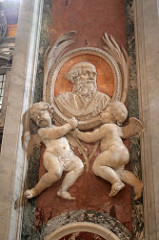
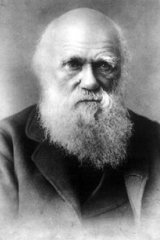
We have a right to know.
Apart from the Sistine Chapel, the other place the Vatican wouldn't let me photograph last week was the crypt containing the tombs of a fair number of popes. Fair enough, I suppose, but I went to have a look anyway: I wanted to make sure that John Paul II really is dead.
I'll make no bones about it (no pun intended), there was no love lost between me and Pope John Paul II. Well, there was certainly no love lost on my behalf; I don't know how the late pontiff felt about me. I don't have much time for religious leaders as a whole, but, in JPII's case, it was the man himself, not just the office, that I disliked. I disliked him immensely—primarily for his stance on contraception, which placed religious dogma before the physical well-being of his flock, the nasty, dangerous little man.
Since JPII's death, they've been trying to make out that he was some kind of saint—literally, in this case. As I reported two years ago, the Roman Catholic Church is looking for evidence "in favour or against" the late Pope John Paul II's suitability to be a saint. They're not talking about scientific evidence, you understand. What they're looking for is anecdotal evidence that JPII should have the letters S-T added to the front of his name. Being religious types, the sort of anecdotal evidence they have in mind is of the non-testable, miraculous kind: pray to JPII, witness a miracle, and Bob's your uncle (and John Paul's your saint). Easy-peasy!
All of which explains (I think) why, as I filed past JPII's tomb (muttering the words you evil, little bastard under my breath—I couldn't help myself), there were about a dozen or so of the faithful in a little roped off area, on their knees, praying at the slab of marble like there was no tomorrow. I felt sorry for them, I really did. These poor people seemed to be nice, ordinary members of the public, who genuinely believed that praying at a piece of rock might actually achieve something. You could see it in their eyes: they were genuinely touched—in both senses of the word. How did it get to this?
Interestingly, a few tombs along, the faithful praying at the tomb of St Peter (est. 1950)—that's Peter the rock (geddit? Nice one Jesus!) upon which the Roman Catholic Church was literally built, the patron saint of cobblers (no, really: the last shall be first, and all that), and, if the Bible is to be believed, one of Jesus's actual apostles—were conspicuous by their absence. Mind you, I suppose he's already got his sainthood.
Shaking my head in literal disbelief, I crept out of the crypt and returned to St Peter's Basilica to take some more photographs.
And then something really strange happened: I pushed the little button on the side of my camera which makes the flash pop up, took a photo of a statue of some woman carrying a book, and pushed the flash back down again. "What's so strange about that?" I hear you ask. Well, for about a month now, the flash on my camera has had a fault: it has been popping up OK, and the flash still works, but there has been something wrong with the mechanism which has been preventing it from popping down again unless I jiggle about with the catch. Only this time I didn't need to do the jiggle—and my camera has been working just fine ever since.
Spooky!
Could a John-Paul-II-hating atheist have been the first to witness one of his miracles? Could the paparazzi's favourite pope end up becoming the patron saint of flash photography? I'll leave the Roman Catholic Church to decide.
But, if they want to try to repeat this minor miracle, the prayer that seemed to work for me is you evil, little bastard.
Postscript:
No sooner have I finished writing the above than I spot the following headline in today's Guardian (the butler reads it): Miracle nun: 'I wrote John Paul II's name and I was cured'.
Holy crap!
The Romans seem to have a thing about fountains. They have them coming out of their ears. I speak metaphorically.
The most famous fountain in Rome is the Trevi Fontain. It's where Anita Ekberg famously went for a paddle in La Dolce Vita. Me neither.
There are all sorts of conflicting legends about how many coins you are supposed to throw into the Trevi Fountain, and what will happen if you do so. Jen's guidebook said, if you throw a single coin into the fountain, you will meet the man of your dreams. I was rather put out when she decided to put the legend to the test. It worked: she threw her coin into the fountain, turned to her right, and there I was!
Then she suggested that I throw a coin into the fountain.
Just for the record, there is not now, nor has there ever been, a man of my dreams. Each to his own and all that. Don't knock it till you've tried it, etc. But what the hell: when in Rome and all that malarkey. So I threw my coin into the fountain, turned to my right and…