System

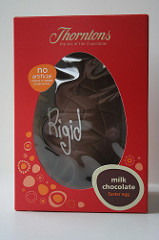
Those of you with long memories might remember that Carolyn and I have our own two-person lottery syndicate. I (very sensibly) choose random numbers each week; Carolyn (very foolishly) picks the same numbers each week. Carolyn's numbers are based on our birthdays, our mutual age, and the numbers of the houses we were brought up in, three doors along from each other. So far, my numbers have won us a total of £80 (or there about). Carolyn's have yet to win us a sausage.

After this evening's draw, Carolyn sent me the following text message:

It's your fault! If you'd been born two weeks earlier we'd have won £10. Typical!

How do you tell your oldest friend in the world that her gambling system is shite?

Gaia hits back

In the 1960s, the scientist and environmentalist James Lovelock (who is dead right about the relative merits of nuclear and wind power, by the way) proposed the Gaia Hypothesis in which he suggested that the Earth functions as a sort of superorganism, reacting via natural feedback loops to natural and man-made changes in environmental conditions.

It is far from clear whether Lovelock was talking metaphorically or literally when he spoke of the Earth as being an organism. If he was talking metaphorically, Gaia is an interesting and potentially useful hypothesis which might help us to look at environmental change from a different perspective. If he was talking literally, it is, of course, utter bollocks.

This morning, I took some cardboard boxes to compost in my magnificent compost bins. As I was tearing up the boxes, a sudden gust of wind snapped in half one of the pieces of cardboard, the corner of which nearly took my eye out. It smarted. It smarted A LOT.

So that's what you get for trying to save the planet.

Sod you, Gaia! I'm off to buy an S.U.V!


Stop Press: You couldn't make this crap up… Not 20 minutes after I had published the above, I went to crush my empty beer can in my trendy new save-the-planet can crusher. Half-way through the crushing process, the can—which was by now a mass of sharp metal edges—fired right out of the crusher and hit me square in the face.

That's it: the planet's knackered.
Great moments in biology

Over in this neck of the woods, we are rightly proud of local lad Percy Shaw (1890–1976), the inventor of the catseye, which has saved untold lives on the nation's roads.

It is said that Shaw's invention was inspired by seeing light reflected off a cat's retina at nighttime.

It turns out that Percy Shaw wasn't the first man of science to investigate reflections from cats' retinas. This from The Eye: a Natural History by Simon Ings (pp.184–5):

In 1703, [French anatomist Jean] Mery noted that a cat's eyes shine much more brightly if you hold the cat underwater…

[W]ell over a century after Mery dunked his cat, [Swedish-born naturalist, Karl Asmund] Rudolphi turned his attention to the directionality of the shining eye. He was able to show that the reflecting eye will emit light along exactly the same line as the direction of the in-going rays. No chemical or biological process is taking place—a point he demonstrated by the simple expedient of shining lights into the eyes of a decapitated cat.

That's the way to do it.

Wid of the mark

H O L Y   C R A P ! Richard Widmark has died!

I thought he'd died years ago. For absolutely yonks, I've been saying that Kirk Douglas was the last remaining cowboy from the golden era of westerns*: the movies my dad was brought up on; the movies that my dad brought me up on.

But I was wrong: Kirk wasn't the last. Richard Widmark was still around.

But I'm right now.

Take care of yourself, Kirk.


* My dad is always careful to make a distinction between 'cowboy films' and 'westerns'. Cowboy films were set in a town (which was actually a film set) and usually starred Gary Cooper; westerns were set on location out in the Bad Lands. Cowboy films would do at a pinch, but westerns were the ones to go and see.

Larking about

BBC: Williams top of Classic FM vote

Vaughan Williams's The Lark Ascending has been voted best classical piece of music by radio listeners for the second year running.

Look, I know diddly-squat about classical music, but I should imagine this sort of thing annoys the real classical music fan about as much as it infuriates me when one of the perennial best-ever pop song polls has seven boy bands in the top ten.

The Lark Ascending: great tune, quintessentially British, actually sounds like a lark, written by Charles Darwin's great-nephew—what's not to like? But best piece of classical music ever? Is that the best you can come up with, culture vultures?

Do us a favour!

Personally, I'd have gone for At the Castle Gate from Pelleas and Melisande by Sibelius (better known to UK readers as the theme tune to The Sky at Night). The first note alone wins if for me. Eat that, Beethoven! Crank it up to eleven. But, like I said, I know diddly-squat about classical music, so I'm not entitled to vote.

Democracy is a load of old bollocks at times.

Pick of the Podcasts

Someone calling themself Intentionally Blank left a comment the other day asking for a list of the podcasts I listen to. Well, Intentionally (if that is your real name), I am happy to oblige [seriously out-of-date list removed].

About bloody time!

Guardian: Britain and France to take nuclear power to the world

Britain and France are to sign a deal to construct a new generation of nuclear power stations and export the technology around the world in an effort to combat climate change…

Britain hopes to take advantage of French expertise to build the power stations that do not rely on fossil fuels. Nearly 79% of France's electricity comes from its highly-developed nuclear power industry. The UK's ageing nuclear plants are ready for decommissioning and supply 20% of its energy needs.

Brown hopes the partnership will create a skilled British labour force who would then work in partnership with France to sell nuclear power stations to other countries over the next 15 years.

Let's hope this is more than just spin, and they have the guts to follow it through.