Swing low

I heard it on the radio first: John Terry has been stripped of the England captaincy by Capello!

Yes, that's right: someone I had never heard of had been removed as 'England captain' by someone else I had never heard of for bending one into the ex-girlfriend of a team-mate.

For those of you as baffled as I was, John Terry, it turns out, is—or, rather, was—the England Men's Soccer team captain. In other words, an overpaid, coiffured softie who can kick a ball. Apparently, captain is official BBC short-hand for men's soccer captain.

Meanwhile, in real sports news, the 2010 Six Nations Championship opens today.

(That would be men's rugby union, for the totally clueless.)


Postscript: Noooooooo!!! BBC: Prince Harry to become RFU vice-patron. If the nasty little ginger shit wants vice, he should follow the footie!

Grutness

Some say that Grutness is a state of mind, but, as I was recently delighted to read in Tim Dee's excellent book The Running Sky, it is also a place:

Grutness
The hamlet of Grutness, Shetland
Image © Tom Pennington, licensed under Creative Commons Licence.

Imagine my even greater delight when I realised that I have actually been within 600 yards of Grutness. In March 1985, some archaeological colleagues and I paid a very wet visit to the nearby ancient settlement of Jarlshof.

Apparently, the name Grutness is from the Old Scandanavian grjót nes, meaning gravel promontory.

So, there you have it: Gruts means gravels.

What does Grutness mean to you chaps?


See also: Gruttish

Not exactly Pythagoras' Theorem

I went to buy a book in Waterstones this week. Its recommended retail price was £25, but there was a sticker on the front saying there was £9 off. Woo-hoo!

The girl on the checkout zapped the book. "Oh, the computer hasn't taken the £9 off!" she said, and she walked away.

I watched open-mouthed as the girl returned a minute later with a pocket calculator and began to punch in a calculation.

"It's £16," I said: "twenty-five minus nine is sixteen."

"You're right!" the girl said, clearly impressed. "I'm hopeless at maths." I didn't say that I could tell.

"The trick is to take off ten and add one," I said. The girl looked at me as if I was from another planet. "Taking off ten and adding one is the same as taking off nine, but it's easier," I tried to explain. The girl looked back at me blankly.

So I paid my money and left.

Thinking about it afterwards, I should have pointed out that 9, 16 and 25 represent the squares on the sides on a classic Pythagorean 3, 4, 5 triangle.

That should have made it a lot easier.

Mirror Man

In celebration of the Good Captain's 69th birthday:

(Anyone else recognise the bearded roadie at 5 minutes and 21 seconds?)

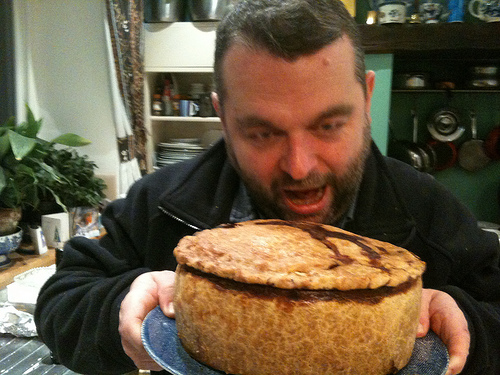
Who ate all the pie?

Man, I feel rough this morning. Can't have been the booze last night: I was remarkably restrained (for me).

Must have been something I ate.

Who ate all the pie?
Me and a road-kill pie yesterday.

Happy New Year, everyone.

Which reminds me…

I'll tell you what I find mildly irritating: the phrase reminds us, as used by scholarly reviewers. You see it a lot in the London Review of Books (my butler reads it). Indeed, if you search for the phrase 'reminds us' on the LRB website, you will see that it has been used 739 times in that august magazine over the years. That's an awful lot of reminders.

Here are a few recent examples, to give you a flavour of the sort of thing I'm on about:

What The Age of Wonder narrates is also, Holmes reminds us, what Banks himself would have been learning. An 'all-seeing eye', 'the sceptical, all-weather eye of Banks', peers out of successive chapters; his gaze sweeps 'steadily round the globe like some vast, inquiring lighthouse beam'.
—Susan Eilenberg, LRB 7 January 2010

In the Sonnets, as Schalkwyk reminds us, the humiliations of rank are never wholly separable from the poet-actor's sense of himself as one whose histrionic trade has made him 'a motley to the view', the fool's costume becoming a substitute for livery and a degrading reminder of the player's role as servant.
—Michael Neill, LRB 22 October 2009

With her own special bite, Atwood singles out for dramatic treatment the girls who worked in the palace and fraternised with Penelope's suitors; she reminds us how pitilessly Odysseus orders them to be hanged, every one.
—Marina Warner, LRB 27 August 2009

Carson reminds us that Aristotle thought that Euripides, 'whatever the ineptitudes of his stagecraft', was 'the most tragic' of the tragic poets.
—Michael Wood, LRB 11 June 2009

By triangulating the relationship between Cecil, Elizabeth and Mary Stuart, Alford reminds us of the very unusual circumstances that shaped Elizabethan politics.
—Simon Adams, LRB 11 June 2009

Yes, thanks for the reminders, chaps! Fancy forgetting something like that—silly old us! We'd forget our own heads, if they weren't screwed on, eh?

No, what the phrase 'reminds us' really means is 'somebody else has said something rather clever and profound, but I'm going to pretend I knew it all along, and make you feel stupid by implying that you should have known it too'.

It must be really great to be as clever as one of those scholarly reviewer types.

Meanwhile, Fitz reminds us that two of the UK's most popular pop songs of all time, Whiter Shade of Pale and Bohemian Rhapsody, both contain the word fandango.

Gunners envy

I see Manchester City F.C. has a new manager, Roberto Mancini.

This is blatant Gunners envy. The Citizens simply couldn't stomach the fact that Arsenal were the only Premiership side whose manager, Arsène Wenger, had a name which was practically identical to the club's. So Man. City had to have Mancini. It was as simple as that.

What nonsense can we expect next? Chelsea Clinton to manage The Pensioners? Trevor Nunn to take over at Goodison? The late Oliver Poole to replace Benítez at Anfield?

Actually, than might not be such a bad idea.