Here, the Howgill Fells have been squashed up against the younger, limestone rocks of the Yorkshire Dales, sliding over the top of them, thereby creating the Dent Fault.
If you do happen to notice one of these in your garden, please let me know.
The Dent Fault was discovered by local lad, Adam Sedgwick, who went on to teach Charles Darwin geology at Cambridge University. He was a great geologist, but could never bring himself to accept his famous pupil's theory of evolution by means of Natural Selection.
Carolyn sent me another of her out-of-the-blue text messages on Monday:
Have you ever used those water-finding sticks? I'm going to make some tonight out of coat hangers.
I texted her back to explain that the word she was looking for was diviners (not dividers, as I had overheard some bloke say the previous week, while he was trying to chat up a very bored-looking woman). I also explained that divining was "utter bollocks, obviously".
Carolyn then texted back to say that she had tried it with coat hangers before and "it definitely worked".
After a few more texts, I rang her. "This has got something to do with bees, hasn't it?" I said. Carolyn laughed. It was indeed to do with bees.
It turned out that she planned to go dowsing to look for a suitable fault line to situate her bee-hive near. Yes, she was still going on about that bollocks about fault lines.
I pointed out that using divining rods to detect energy vibrations emanating from fault lines was using a technique which doesn't work to detect something which doesn't exist emanating from something which isn't there.
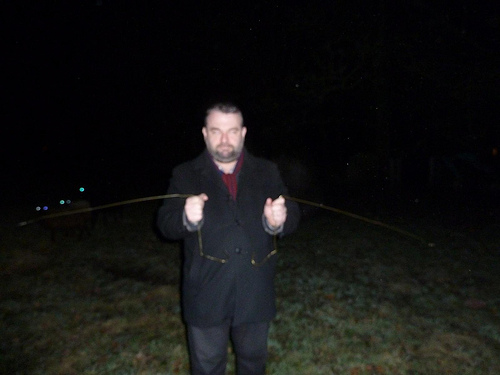
Which is how I came to find myself standing in a dark field holding a pair of bent coat-hangers on Tuesday night:
An expert in the field on Tuesday.
"It works! It works!" screamed Carolyn as her coat-hangers crossed.
"It doesn't work; you tilted your hands," I said.
"No I didn't; they definitely moved!" said Carolyn. "Here, you have a go!"
So I had a go. Walking over exactly the same spot, I watched open-mouthed as my two coat-hangers miraculously did not cross, but splayed wide apart.
"You moved your hands!" said Carolyn.
I think not. The dowsing rods had evidently detected my negative vibes.
Tawny owls turn brown to survive in warmer climates, according to scientists in Finland.
Feather colour is hereditary, with grey plumage dominant over brown. But the study, published in the journal Nature Communications, found that the number of brown owls was increasing.
As winters become milder, the scientists say, grey feathered tawny owls are likely to disappear.
This study indicates that the birds are evolving in response to climate change.
If you follow the Gruts comments, you will doubtless be painfully aware of regular commenter Nite Owl. In your less guarded moments, you might even have wondered what he—or possibly she—looks like.
Well, wonder no longer! Sources close to Gruts have provided me with this photograph of said Owl in all his—for it is indeed a man—splendour:
A Nite in shining armour yesterday.
Understandably, Mr Owl would prefer to remain anonymous.
But, thanks to the marvels of modern technology, I have been able to employ sophisticated, pattern-matching software to extrapolate the missing data from the above image, and reconstruct Nite Owl's missing features to an estimated accuracy of 2%:
Nite Owl unmasked.
Another mystery solved: so-called Nite Owl is, in reality, Scotch funnyman Billy Connolly.
For reasons I won't bother you with, I had occasion this week to search for the presumably meaningless word 'mnmn' on Google. The search yielded 3,370,000 results. This will presumably increase to 3,370,001, once Google indexes the page you are reading now.
Intrigued, I dug around some more. There are 159,000 images of 'mnmn' (some of them rather rude), and 3,370 videos, including this one of the Muppets' legendary Mahna Mahna song (presumably a typo), with its soundtrack removed for copyright infringement reasons:
Similarly, prrt yields 161,000 Google hits; gnnn 202,000; and even hooma-toobs manages and impressive 75 results.
It's time to face reality, my friends: I appreciate the irony of this coming from me of all people, but there is simply too much crap on the Internet.