This afternoon, I promised Stense I'd send her my chilli, crab and lemon spaghetti recipe, so I've put it on Gruts for everyone to see.
You should give it a go: it's rather easy, and extremely tasty.
A bit like Stense, in fact.
🦆
This afternoon, I promised Stense I'd send her my chilli, crab and lemon spaghetti recipe, so I've put it on Gruts for everyone to see.
You should give it a go: it's rather easy, and extremely tasty.
A bit like Stense, in fact.
Occasional Gruts commenter and Friend of Charles Darwin, Peter McGrath, gets some great publicity for his big project:
BBC: Darwin's Beagle ship replica plan
Plans are being drawn up to build a £3.3m working replica of the boat that took Charles Darwin around the world at Milford Haven in Pembrokeshire. Fundraising for the project, which would mark the 200th anniversary of Darwin's birth in 2009, is under way. The aim is to built a seaworthy vessel identical to the HMS Beagle on the outside, but with a modern interior…
Mr McGrath said the ship would look identical to the original Beagle on the outside but would have a 21st century interior with diesel auxiliary engines and generators. He said he hoped the fi[ni]shed vessel would inspire the scientists of the future and be used by researchers and scientists from across the world.
Is it unbelievably hot this week, or is it just Stense?
To quote the Good Captain, sun's all hottin' and a rottin' hot. If this is global warning, then I'm against it. 38°C it was in my car yesterday afternoon. That's Gas Mark 2 in old money.
I went for a meeting in a hot and sticky, pokey little conference room on Tuesday, with only a noisy fan and an empty water cooler to alleviate our suffering. Just before the meeting started, a colleague's phone rang with a ridiculous, plinky, unrecognisable ringtone.
"Oh good, the ice cream van's arrived!" called out another colleague. "Two choc-ices and a cornet, please!" he added, as the first colleague left the room to answer the call.
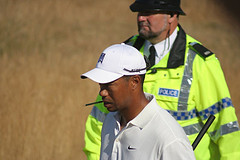
In the second greatest highlight of his golfing career (the greatest, of course, being meeting Jack Nicklaus), my dad, age 71, is finally taking part in the Open Golf Championship this year. OK, it's only as a course steward, but he reckons that kind of counts. Look out for him on the fifth hole every day this week. You can't miss him: he's the one who looks like Jim Rockford.
My dad and uncle and I attended one of the unofficial practice days on Monday. It's the closest thing we have to a Carter family tradition. We've gone to a practice day every year the Open Championship has been held in the North West of England since I was this high to Sam Snead. This year was extra special, because the Open has finally returned to the Royal Liverpool Golf Club on the Wirral—just down the road from where I was brought up.
You'll notice I'm not referring to it as the British Open, by the way. Dad's very particular about that: there's the US Open, and the Irish Open, and the Scottish Open, and so forth; but, when it comes to the British Open, the adjective is superfluous: there will only ever be one The Open. It's a bit like in soccer: so-called derby matches can happen in any locality, but, when you talk about The Derby, we know you mean Liverpool beating Everton.
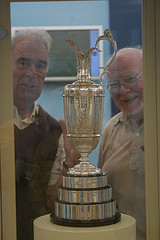
The famous Open Championship Claret Jug is perhaps the most tasteful trophy in the whole of sport. Interestingly, I learnt from a display at Hoylake this week, there are two claret jugs: the genuine one (which resides at the British Golf Museum at St Andrew's), and the replica one that the championship winner is presented with and gets to keep for a year. As dad pointed out on Monday, surely that makes the replica trophy more genuine than the so-called genuine one. The British Golf Museum seems to agree: their website describes their claret jug as the replica.
Those golfers are crazy.
See also: My 2006 Open Championship photos
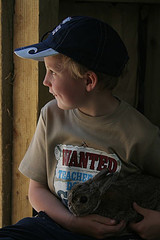
It was Carolyn's son Aran's eighth birthday on Monday. Carolyn tricked me into agreeing to go along to the party to take photos. She was pretty devious, asking me if I wouldn't mind taking a few photos of Aran, then, after I'd agreed, pointing out that it would be his birthday, and there would be 21 other kids there.
Actually, it was a pretty good do, which was held on a local organic farm, where the kids got to ride in a tractor trailer, feed farm animals, play in a lavender maze (which was really cool) and have a hay fight. It was a glorious day, and the views over the Welsh hills and Dee Estuary were magnificent (albeit marred by the new off-shore wind powerstation).
Aran is certainly his mother's son all right. Guess what he wanted (and got) for his birthday present. Go on, you'll never guess…
A water butt.
Last Monday evening, I felt a bit peckish just before I went to bed. So I looked in the fridge and found some pickled beetroot. We don't usually have pickled beetroot, so I tucked in. It was delicious.
Next morning, I discovered why you shouldn't eat pickled beetroot on its own. How can I put this delicately? Well, let's just say it comes out beetroot-coloured.
Yes, I know: too much information!
Not content with dumbing down history, Madame Tussauds, it seems, now wants to dumb down the entire universe:
Guardian: Where have all the planets gone?
There is splodge from an egg on the side of the pale green copper dome on Marylebone Road that could have been hurled at the former London Planetarium by a furious astronomer.
But the wonders of the cosmos no longer bring crowds to a reverent halt and yesterday Madame Tussauds reopened the rebranded "Stardome" with a cartoon about an alien boffin who believes every resident of our planet is a celebrity. "It's a no-brainer," said Nicky Marsh, marketing director of the waxwork attractions. And, in several senses, she was right.
Hitchin and I visited the London Planetarium during August Bank Holiday weekend in 1990. I can confirm that, even then, it was hardly pulling in the crowds. There were three different queues: one for Madame Tussauds, one for the planetarium, and one for both. Hitchin and I were the only people in the queue for the planetarium, while the other two queues stretched out into the street.
As we waited patiently for the next show, a management gorilla in a penguin suit approached us and demanded to know why we weren't in either of the queues for Madame Tussauds.
"We just want to see the planetarium," explained Hitchin.
"What's wrong with Madame Tussauds?" whooped the gorilla.
"Nothing. It's just not our sort of thing."
"Why not? What's wrong with it?"
"Well… I just don't like dummies, I suppose."
"Why on earth not?"
"Erm, well… I'm allergic to wax."
We didn't like to mention my unpleasant experience with a candle as a child.
See also: Planetarium (highly recommended)
Whoa! STOP PRESS! I've just realised something:
That BBC news report I quoted in my previous item about homeopathy says the following (my emphasis added):
The Royal London Homeopathic Hospital is run by doctors who are also homeopaths and who treat conditions such as hay fever and rheumatism. They are also furious that some homeopaths are making these false claims about malaria.
The hospital's Director Peter Fisher told Newsnight "I'm very angry about it because people are going to get malaria—there is absolutely no reason to think that homeopathy works to prevent malaria and you won't find that in any textbook or journal of homeopathy so people will get malaria, people may even die of malaria if they follow this advice."
But hang on a cotton-picking nanosecond, what about this other BBC article which I have referred to previously (again, with my emphasis added—and I have merged some of the paragraphs to save space):
BBC (10-Apr-2005): Malaria row inspired homeopathy
…This weekend, supporters of homeopathy are celebrating the 250th anniversary of the birth of Samuel Hahnemann—the man widely accepted as the founder of homeopathy…
[I]t was while translating medical texts that he made his biggest breakthrough—the realisation that taking quinine to treat malaria produced the same symptoms as the illness itself. Dr Hahnemann found a piece by another doctor, Cullen, who was examining the use of quinine (which he referred to as Peruvian Bark) to treat malaria—or Marsh Fever as it was then known. Dr Cullen said the bark was successful because of its astringent and purgative properties. But Dr Hahnemann took issue with this. He argued that other medicines had the same properties—but had no effect on malaria. To prove his point, he decided to experiment with quinine, taking the drug himself. The results were to prove hugely significant.
According to John Saxton, president of the faculty of homeopathy which promotes the academic and scientific development of the discipline, they effectively laid the foundation stone for the creation of homeopathy. "He took a dose of Peruvian Bark—four drams—and developed all the symptoms of malaria apart from the fever. For as long as he continued to take the bark, he had the symptoms and when he stopped it, they stopped. It set him thinking." Dr Hahnemann came to the conclusion that it was the very fact that quinine produced symptoms so similar to malaria itself that made it a useful medicine—in effect he discovered that like can be used to fight like.
In other words, although "there is absolutely no reason to think that homeopathy works to prevent malaria", the belief that like can be used to fight like specifically with malaria "laid the foundation stone for the creation of homeopathy".
I'm sorry (actually, I'm not), but doesn't that totally destroy the supposed foundation of homeopathy?
As I believe I have made abundantly clear, I have no time at all for the snake-oil-peddling charlatans that go by the name of homeopaths.
Criticising so-called complementary medicine comes second only to suggesting that we should cut smokers a bit of slack when it comes to provoking virulent email attacks. For a bunch of tree-hugging hippies with flowers in their hair, the alt.therapy brigade sure can turn pretty belligerent when you call a placebo a placebo. Here is some recent feedback:
Material doses of medicine are very last century. Physicists are realizing that there is so much out there that we don't understand and just because we don't understand it doesn't make it bad or mad or wrong. The world was believed to be flat and people died because of their belief that the world was round.
For material doses, read actual doses. And note the almost obligatory use of the we-used-to-think-the-world-was-flat argument. Well, at least they didn't try to rope in Galileo as a persecuted predecessor this time. In an earlier email, the same correspondent advised me (in capital letters) to:
THINK before you speak and learn the true facts
…and pointed out:
Homeopathy at least has never KILLED ANYONE
To which I rather wearily replied:
You are correct when you say that real medicines sometimes kill people, whereas homeopathic ones never have. Just listen to what you're saying. Don't those facts tell you anything? Real medicines have active ingredients which sometimes affect people in undesirable ways (they're known as side-effects). They also happen to have rid the world of smallpox, scarlet fever and (very nearly) polio. Homeopathic medicines have no active ingredients, so cannot possibly harm (or cure) anyone.
But maybe I was wrong. Maybe homeopathy isn't so harmless after all:
BBC: Malaria advice 'risks lives'
Some high street homeopaths claim they can prevent malaria, a Newsnight investigation has found.
Secret filming revealed homeopaths were claiming their preparations could be used instead of anti-malarial drugs to protect travellers in high risk areas such as sub-saharan Africa…
Dr Behrens [of the London School of Hygiene and Tropical Medicine] has treated patients who fell for the homeopaths claims "We've certainly had patients admitted to our unit with the malignant form of malaria who have been taking homeopathic remedies and without a doubt the reason that they were taking them and not effective drugs was the reason they had malaria."
It's time someone put a stop to this nonsense. They'll be trying to tell us our kids don't need MMR jabs next.
Carolyn had her hair cut on Thursday. She usually agonises about it for days beforehand, trying to decide whether to have her hair cut really quite short this time, then plays it safe and has about a quarter of an inch taken off. On Thursday, however, she sent me a text message to say she'd had four whole inches cut off. So I gave her a call to see if she had recovered from the trauma. She was driving her kids in the car at the time and answered on her hands-free set:
Me: So how did it turn out, then?
Carolyn: Oh, it's not too bad, I suppose.
Me: What do the children think of it?
Carolyn: They haven't noticed it yet.
Aran (her son): What haven't we noticed, mum?
Me: Your mum's new haircut. How does it look, Aran? Do you like it?
[Long pause as Aran inspects his mum's hair.]
Aran: Mum, you've been eating Kit-Kats!
Carolyn: No I haven't!
Aran: Yes you have: I can smell them!